If your company sells goods in or from the UAE, client screening is no longer something only banks do. Many trading companies, and in particular dealers in precious metals and stones, fall within the UAE's anti-money laundering and counter-terrorist financing framework, and are expected to know who they deal with. This checklist sets out the practical steps. It is a starting point, not legal advice: your exact obligations depend on your activity and your supervisor.
1. Know which rules apply to you
The UAE framework is built on Federal Decree-Law No. 20 of 2018 on anti-money laundering and combating the financing of terrorism, its implementing regulations, and guidance from your supervisory authority. Confirm with your adviser whether your business is a designated non-financial business or profession (DNFBP), and which authority supervises you.
2. Screen against targeted financial sanctions lists
- The UN Security Council Consolidated List, which applies in the UAE.
- The UAE Local Terrorist List, published by the Executive Office for Control and Non-Proliferation (EOCN). Subscribe to its notification service so you hear about changes immediately.
- Other lists your risk assessment calls for, such as US OFAC, EU and UK lists, especially if you trade in US dollars or with those markets.
Screen the client, the company, and its shareholders, directors, beneficial owners and signatories, not only the person you talk to.
3. Re-screen when lists change
A client who was clear at onboarding can be listed next month. Sanctions lists change without notice, so screening must be repeated whenever a list is updated, and records kept of each run.
4. Identify politically exposed persons
A politically exposed person (PEP), their relatives and close associates are not prohibited, but they need enhanced due diligence: source of funds and wealth, and senior management approval. Use a PEP data source, and also ask the client directly in your KYC form.
5. Check adverse media
News reports of fraud, corruption or smuggling often appear before any official listing. A search of the client's name with financial-crime terms is a simple, effective control. Record what you found and why it was or was not relevant.
6. Apply country risk
Treat clients connected to countries under an FATF call for action as the highest risk, and those on the FATF list of jurisdictions under increased monitoring (the grey list) with extra care. Review your country table after each FATF plenary, three times a year.
7. Collect and date KYC documents
- Passport and Emirates ID, with expiry dates.
- Trade licence and, where relevant, TRN certificate.
- Proof of address, and ownership details for companies.
- Where your policy requires it, a police clearance (good conduct) certificate.
8. Decide, record and report
Every potential match needs a decision by a responsible person, with a written reason: a false positive (a different person) or a confirmed match. Confirmed matches against sanctions lists require immediate action, including freezing obligations and reporting through the channels your supervisor specifies, such as goAML. Keep records for the period the law requires.
9. Make it part of the sales process
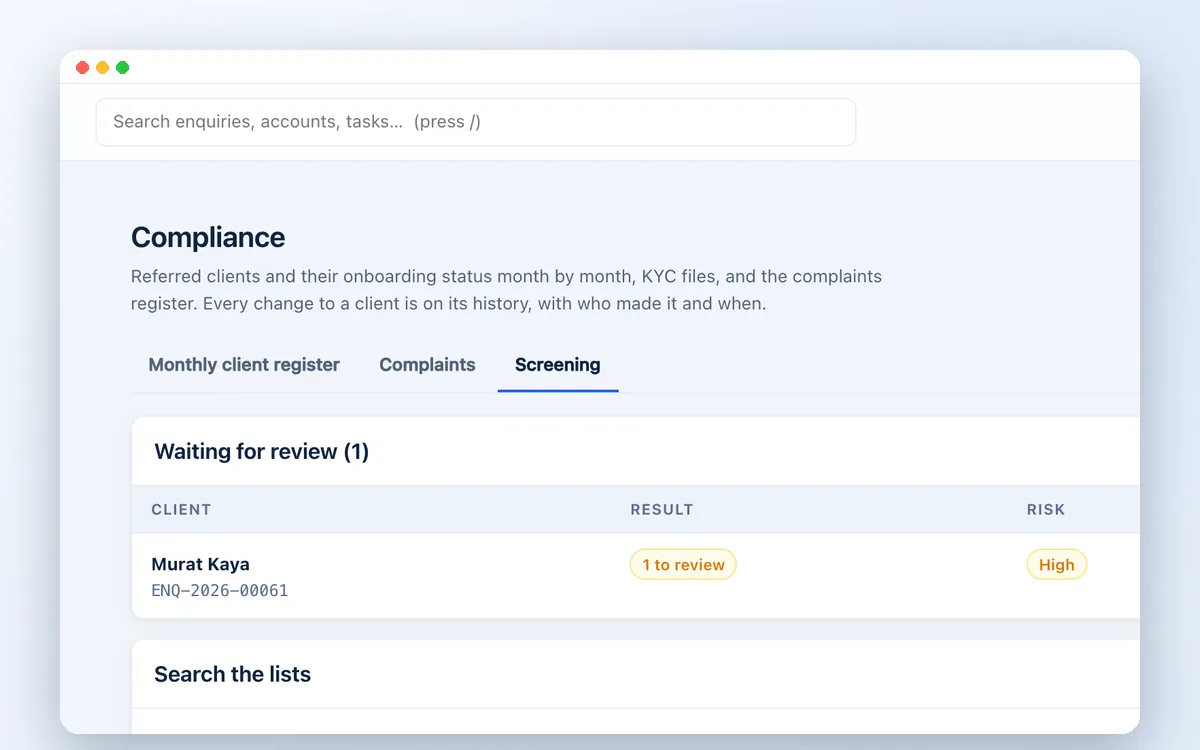
Screening that sits in a separate spreadsheet is easily skipped. The most reliable control is a rule in your CRM: a client cannot be approved, or an order confirmed, until screening has been completed and reviewed.
How Zetabytecloud CRM helps. Automatic screening against UN, US OFAC, EU and uploaded UAE lists, PEP and adverse media checks, country risk, documented decisions and an approval gate, all on the client record. See AML & KYC screening.